Google is piloting an interview round where you may use AI. One thing it reportedly grades is how you check the AI's work.
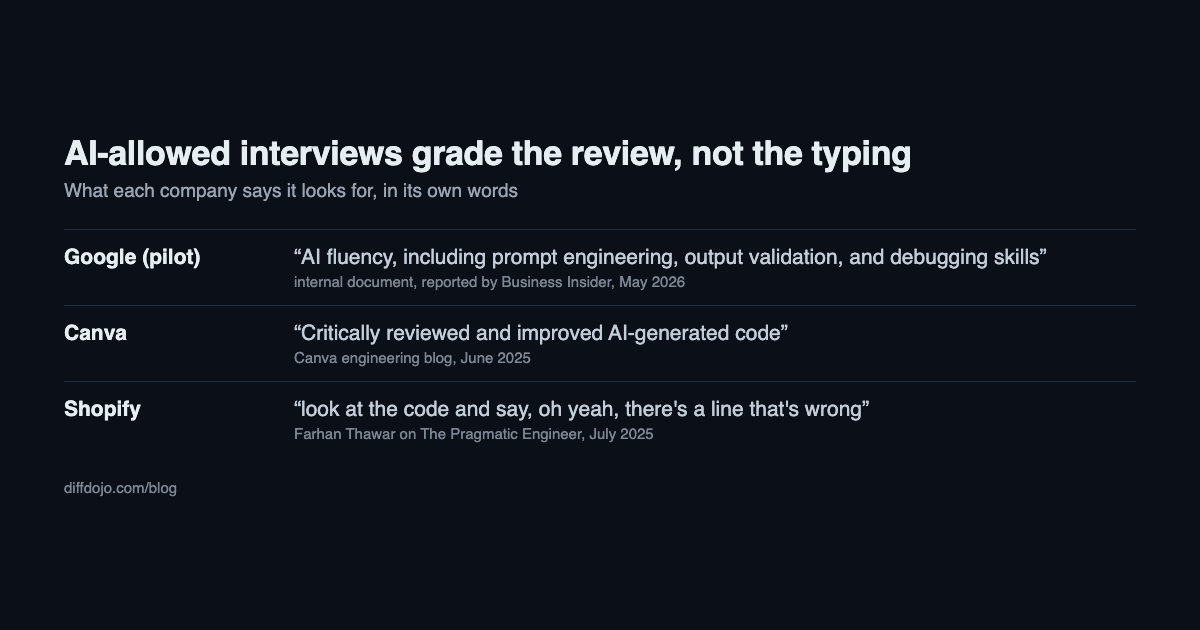
In May, Business Insider reported on an internal Google document about a new pilot for software engineering interviews. The document said the pilot would begin in the second half of 2026 and let junior to mid-level candidates for select US teams use an "approved" AI assistant in the "code comprehension" round, where they read, debug and optimize an existing codebase. According to the document, "interviewers will evaluate AI fluency, including prompt engineering, output validation, and debugging skills." A Google spokesperson confirmed the plans and said the assistant would be Gemini. Google hasn't published the format, so treat the details as reported.
The round exists elsewhere already
Google would be late to this, not early. Canva wrote about its AI-allowed round in June 2025: it replaced the old computer science fundamentals screen for backend and frontend roles, and the signals of success include having "critically reviewed and improved AI-generated code". A follow-up in October 2025 lists as a criterion whether candidates "critically evaluate AI outputs and iterate toward better solutions".
In July 2025 Meta confirmed to Business Insider that it was testing a coding interview in which candidates have an AI assistant, after 404 Media reported an internal post about it. Meta hasn't published a rubric. A former Meta engineer's prep guide says the round is scored on the same competencies as the classic one, including verification: "Do you check the AI's output before moving on?" That's a prep company's reading, not Meta's.
Shopify's head of engineering, Farhan Thawar, told The Pragmatic Engineer that the company is "embracing" AI in interviews, because "the AI will sometimes generate pure garbage" and he wants candidates who can "look at the code and say, oh yeah, there's a line that's wrong." Interview vendors followed: Karat launched interviews in December 2025 where candidates work on multi-file projects with an integrated assistant.
Output validation is code review under a clock
Strip the AI part away and these rounds test the same thing: an assistant hands you plausible code, and you have to decide whether it does what was asked before you build on it. That's a code review, done in minutes, out loud, with an interviewer watching how you read. Practice problems that only grade whether your own code passes don't train it.
Here's what the AI's output can look like. You asked for a helper that returns one page of results for an API whose pages start at 1, and the assistant produced this.
api/pagination.py
+5
It's four lines, the docstring is right, and if the assistant also wrote a test that asks for page 2 of 100 items and checks it gets 20 back, that test passes.
What a validating candidate says
Line 3 treats the page number as zero-based while the docstring and the API count from 1. Page 1 returns items 20 to 39, so the first 20 results are never shown, and the last page comes back empty. A test that only checks the length of a page can't see it. Page 0 and negative pages are also accepted without complaint.
What earns the credit in an interview is saying it, then proving it: "page 1 should start at index 0; let me check page_of(list(range(5)), 1, 2), which returns [2, 3] instead of [0, 1]; the fix is start = (page - 1) * per_page, and I'd reject page < 1."
How to practise for it
The habits these rounds reward are the ones a good reviewer already has: read the request before the code, check the boundaries (first, last, empty, invalid), run one concrete example in your head or in the shell, and say what you'd change in a sentence someone else can act on. Our post on how the coding interview is turning into a code review interview covers the wider shift; the DiffDojo library has realistic AI-written pull requests to practise on, each graded on whether your comment named the planted bug, or whether you approved one that had none.
Try a review
Validate an AI-written pull request before you read the answer.
Leave inline comments and a verdict, then see what you caught. One free PR in every stack, no signup.
Browse the library →