Open-source projects now write down how they treat AI pull requests. Here is what six of their policies ask of the reviewer.
On July 30, Perl's core repository gained a file called AI_POLICY.md. Most of it is about contributors, but one line changes how a maintainer reads an incoming pull request: "LLM-generated prose is grounds for dismissing a contribution out of hand". Perl isn't alone. QEMU, curl, Kubernetes, LLVM and Ghostty have all published rules for AI-assisted contributions, and they disagree about almost everything except one thing: the person who opens the pull request owns what's in it.
Six policies, side by side
QEMU is the strictest. Its code provenance rules, adopted in June 2025, tell maintainers to "DECLINE any contributions which are believed to include or derive from AI generated content." The reason is legal, not quality: QEMU relies on the Developer's Certificate of Origin, and it considers the copyright status of model output "ill-defined". Using AI for research, static analysis or debugging is fine as long as its output doesn't end up in the patch.
Perl core bans AI agents from creating issues or pull requests and, with narrow exceptions (human-verified security analysis, translation), treats LLM-written prose, including PR descriptions and documentation, as reason enough to reject. LLM-written code "may be accepted", but not code "that you could not (with sufficient time available) have written yourself", and any AI-generated part of a contribution "must be disclosed". The policy covers modules the core team owns; dual-life modules maintained by their authors can decide for themselves.
Kubernetes added an AI guidance section to its pull request guide in December 2025 and updated it in April 2026. Contributors disclose AI use in the PR description, and must not credit the AI as a co-author or with an assisted-by style trailer; the project's CLA check now flags AI co-authors, since, as its blog puts it, "AI agents are not able to solve these contributor license agreements". "Large AI generated PRs and AI generated commit messages are not allowed", and replies to review comments must be written "without relying on AI tools", or "the PR will be closed". A post on the Kubernetes blog in June put the reason in one line: "reviewers expect to engage with humans, not with AI."
LLVM adopted a human-in-the-loop policy in January 2026. Contributors "must read and review all LLM-generated code or text before they ask other project members to review it", note substantial tool use where authorship is normally recorded (an Assisted-by: trailer is the suggested form, the exact thing Kubernetes forbids), and are strongly encouraged to write PR descriptions themselves. Its golden rule is the one I'd frame for any team: a contribution "should be worth more to the project than the time it takes to review it."
Ghostty's AI_POLICY.md welcomes AI as a tool but requires that "all AI usage in any form must be disclosed", naming the tool and the extent. Its sharpest line is about understanding: "If you can't explain what your changes do and how they interact with the greater system without the aid of AI tools, do not contribute to this project." Contributors who submit clearly AI-generated slop are added to a public list that blocks their future contributions. (You may read that Ghostty banned AI code outright. Its policy file says otherwise.)
curl holds AI-assisted code to the same bar as any other in its contribution guide: coding standards, docs, tests. The exception is security and other issue reports, where AI use "must" be revealed, and "We ban users immediately who submit made up fake reports to the project." In January Daniel Stenberg ended curl's bug bounty after "an explosion in AI slop reports"; starting in 2025, the share of submissions confirmed as vulnerabilities fell below 5%.
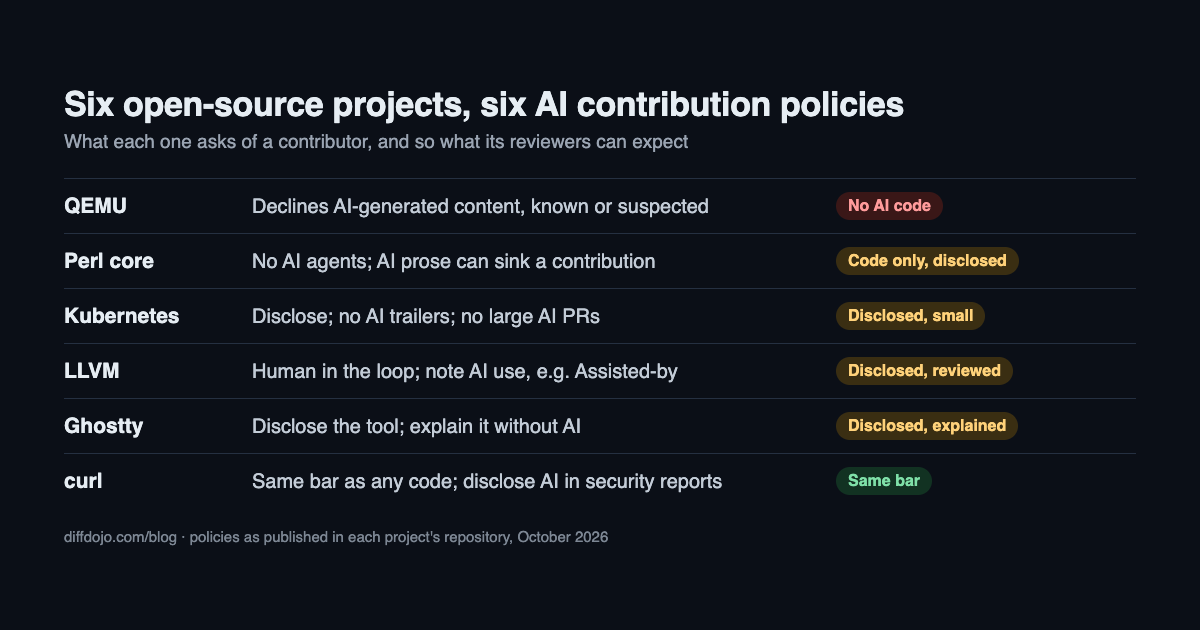
What the policies hand to the reviewer
Read them from the other side of the pull request and a pattern shows up. None of these policies relies on an AI detector. The ones that allow AI-assisted code make the contributor responsible for understanding it, and most ask them to say what they used; QEMU instead turns generated content away, and curl asks for disclosure and human verification when AI was used to find a reported problem. Either way, someone has to tell whether the contributor understands the change, and that is review work.
- Read the disclosure first, and don't trust its absence. A disclosure tells you to read the diff the way you'd read generated code: plausible names, confident comments, edge cases that look handled. No disclosure tells you nothing; curl doesn't even ask for one on ordinary PRs.
- Ask the author to explain one line. Ghostty makes explaining your change a condition of contributing, and Kubernetes expects review replies written without AI. A reviewer's question about a specific line is the cheapest test of that, and the answer usually tells you more than the diff does.
- Weigh review cost against value. LLVM's golden rule gives a reviewer permission to decline a PR that costs more to review than it's worth, and its docs give reviewers a standard reply for it. Large generated PRs are where that trade goes wrong fastest, which is why Kubernetes bans them outright.
- Know your own project's rule. The same
Assisted-by:trailer is LLVM's suggested label and forbidden in Kubernetes. A reviewer who works across projects can't check a PR against a policy they haven't read.
Try the second check on a small diff
Here's the kind of pull request those policies are written for: small, tidy, disclosed. It adds a helper that turns an HTTP Retry-After header into seconds to wait. The description says "This PR was written in part with the assistance of generative AI". Read it as if you had to ask the author one question.
client/retry.py
+12
It appears to handle both forms the header can take, and the happy-path tests that come with a change like this pass. It reads like something you'd merge.
What a trained eye asks about
Line 11 can return a negative number. A server that sends a date that has already passed, or a clock that runs a few seconds ahead of the server's, turns "wait until 12:00:05" into "wait minus three seconds", and depending on the caller that means an error from time.sleep or an immediate retry. Line 8 has the opposite problem: float() happily accepts "inf", "nan" and "-5", none of which are valid delay-seconds, so a misbehaving server can crash the caller or, with asyncio.sleep, make it wait forever. And line 10 doesn't always return a time zone: for a date without one, such as the old asctime form that HTTP recipients still have to accept, parsedate_to_datetime returns a naive datetime, and subtracting an aware one from it on line 11 raises TypeError.
The comment that earns full marks: "clamp to zero and reject anything that isn't a finite non-negative number; the header comes from the network, so line 8 should parse digits, not any float. Treat a date that parses without a zone as UTC before subtracting." And the question for the author, in the spirit of Ghostty's and Kubernetes' rules: what happens when the date is in the past?
Practise the same check
The second check, asking what happens at the edges of a confident-looking change, is the one these policies lean on and the one that's easiest to skip on a small diff. One PR in the library to try before you read any answers: Add a token-bucket rate limiter (Python), then the rest of the Python library. If you review for an open-source project, our security checklist for AI-written pull requests covers the parts of a PR these policies don't.
Try a review
Review a real-looking AI pull request before you read the answer.
Leave inline comments and a verdict, then see what you caught. One free PR in every stack, no signup.
Browse the library →