A permission check that wasn't awaited said yes to everyone, because a pending promise is always truthy.
Strawberry GraphQL's advisory GHSA-pfvf-fwfp-25mp (CVE-2026-107728, rated high, CVSS 7.5) is about a value nobody waited for. On a synchronous field resolver, PermissionExtension.resolve() checked whatever has_permission() returned for truthiness. A permission written as a plain def that returned an awaitable got treated as synchronous, so the awaitable was never awaited, and in the advisory's words: "An awaitable is always truthy, so the check passes even when it resolves to False and the protected resolver runs." Versions 0.217.0 through 0.326.0 are affected. Patrick Arminio's PR #4605, merged on August 31 and released as 0.326.1, makes the synchronous path fail closed: if the check hands back an awaitable, the request gets an error instead of the data. The nixpkgs security tracker picked it up on October 10.
JavaScript had the same bug in March, minus the framework indirection. In StudioCMS's S3 storage manager (GHSA-mm78-fgq8-6pgr, CVE-2026-32101), isAuthorized() is declared async and the POST and PUT handlers test it as !isAuthorized(type) with no await. As the advisory puts it, "a Promise object is always truthy in JavaScript", so the negation is always false and the 401 never fires: "Any authenticated user with the lowest visitor role can upload, delete, rename, and list all files in the S3 bucket." Patched in 0.3.1; the fix the advisory gives is an await on both calls.
Why it survives review
The line with the bug usually isn't in the diff. A check that was synchronous yesterday becomes async today because it now needs the database, and every caller that uses its result as a boolean is now wrong without a single character changing. MDN is blunt about it: "Async functions always return a promise." So if (!check()) is now asking whether an object exists, and the answer is always yes.
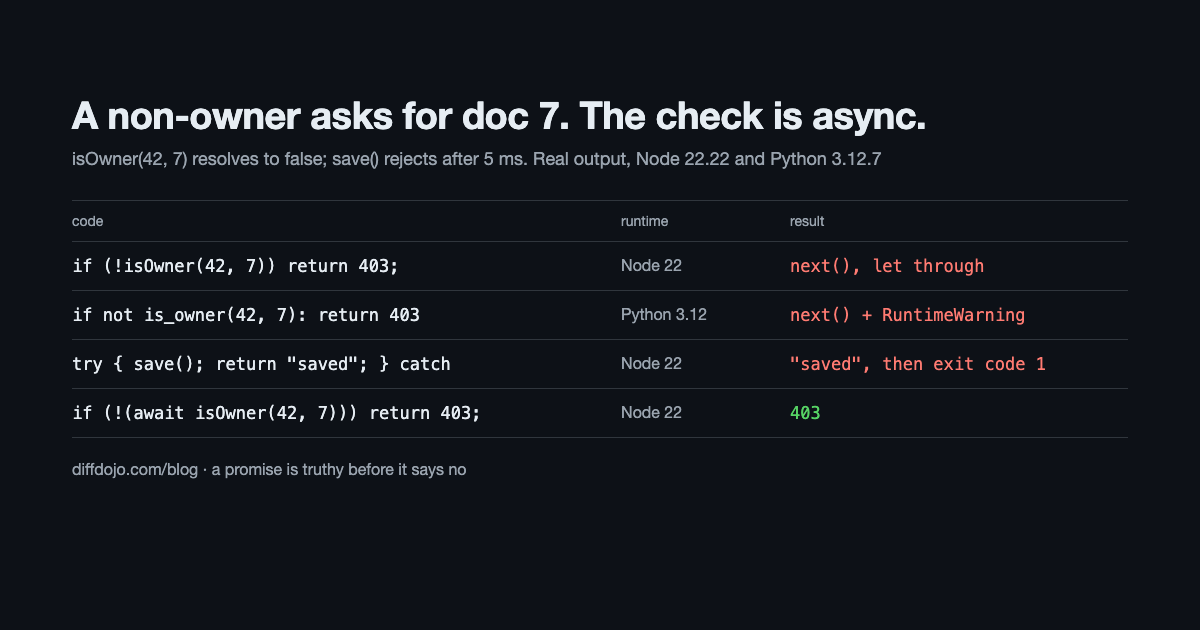
The tools catch less than you'd expect. typescript-eslint's no-floating-promises defines a floating promise as "one that is created without any code set up to handle any errors it might throw" and warns about "improperly sequenced operations, ignored Promise rejections, and more", but it "only detects apparently unhandled Promise statements" and needs type information. A promise inside an if is the job of no-misused-promises and its checksConditionals option. The compiler on its own is patchy: in our run, tsc --strict 5.9.3 flagged if (isOwner(u, d)) with TS2801 ("This condition will always return true since this 'Promise<boolean>' is always defined") and compiled if (!isOwner(u, d)), the shape both advisories had, without a word. Python itself only notices at runtime, and mypy only with its opt-in truthy-bool check: asyncio's docs say that when a coroutine function is called but not awaited, "asyncio will emit a RuntimeWarning". That's a warning, not an error: in our Python 3.12 run the same unawaited owner check printed it and let the request through anyway.
The same missing word does quieter damage when nothing reads the result. A save() that isn't awaited inside a try never reaches the catch, so the handler reports success and the rejection lands later with nobody listening. In our Node 22 run it took the whole process down with exit code 1. The forEach with an async callback version of this has its own walkthrough.
Spot it in a small diff
An agent moves an ownership check off a list cached on the session, which went stale whenever a document changed hands, and onto a database lookup:
src/middleware/requireOwner.js
+3 -2
The new check reads the owner from the source of truth, handles a missing document, and the middleware below it is untouched, so the 403 path looks exactly as it did before.
What a trained eye flags here
Line 3 makes isOwner return a promise, and line 9, which the PR didn't touch, still uses it as a boolean. !isOwner(...) is ! applied to a pending promise, which is always false, so every signed-in user reaches next() for every document. The change that was meant to tighten the check removed it. Nothing errors: owners still get in, and a test that only logs in as the owner stays green.
The comment that earns full marks: "line 3 makes isOwner async, but line 9 still calls it without await, so the condition tests a promise, which is always truthy, and the 403 never fires. Make requireOwner async and write if (!(await isOwner(req.user, req.params.docId))), check every other caller of isOwner, and add a test where a non-owner gets a 403." On Express 5 a database failure in the now-async middleware still reaches the error handler: the error-handling guide says route handlers and middleware that return a Promise "call next(value) automatically when they reject or throw an error". Express 4 ignores that promise, so there the body needs a try/catch that calls next(err), or a failed lookup becomes an unhandled rejection. Turning on no-misused-promises keeps the next caller honest.
Practise on the same bug class
A PR in the DiffDojo library has this bug class, an async call nobody waits for: Save edited team roles in one batch (React). Try it before you read the answer.
Try a review
Find the line that acts before the work is done.
Leave inline comments and a verdict, then see what you caught. A free account unlocks 1 PR of your choice. The pass opens the full library.
Review the team roles PR →