How to keep your code reading skills sharp when AI writes the code
To keep your code reading skills sharp when AI writes the code, read some code every working day without the assistant's help and check yourself against an answer. Predict what a change does before you run it. Trace one concrete input through it by hand. Explain it in your own words, then let the assistant grade your explanation instead of supplying its own. No study has tested this routine as a whole. It is built from what the participants who kept their understanding did in the experiments described below. Writing speed can fade without much harm. Reading cannot, because reading is the part of the job the assistant left to you.
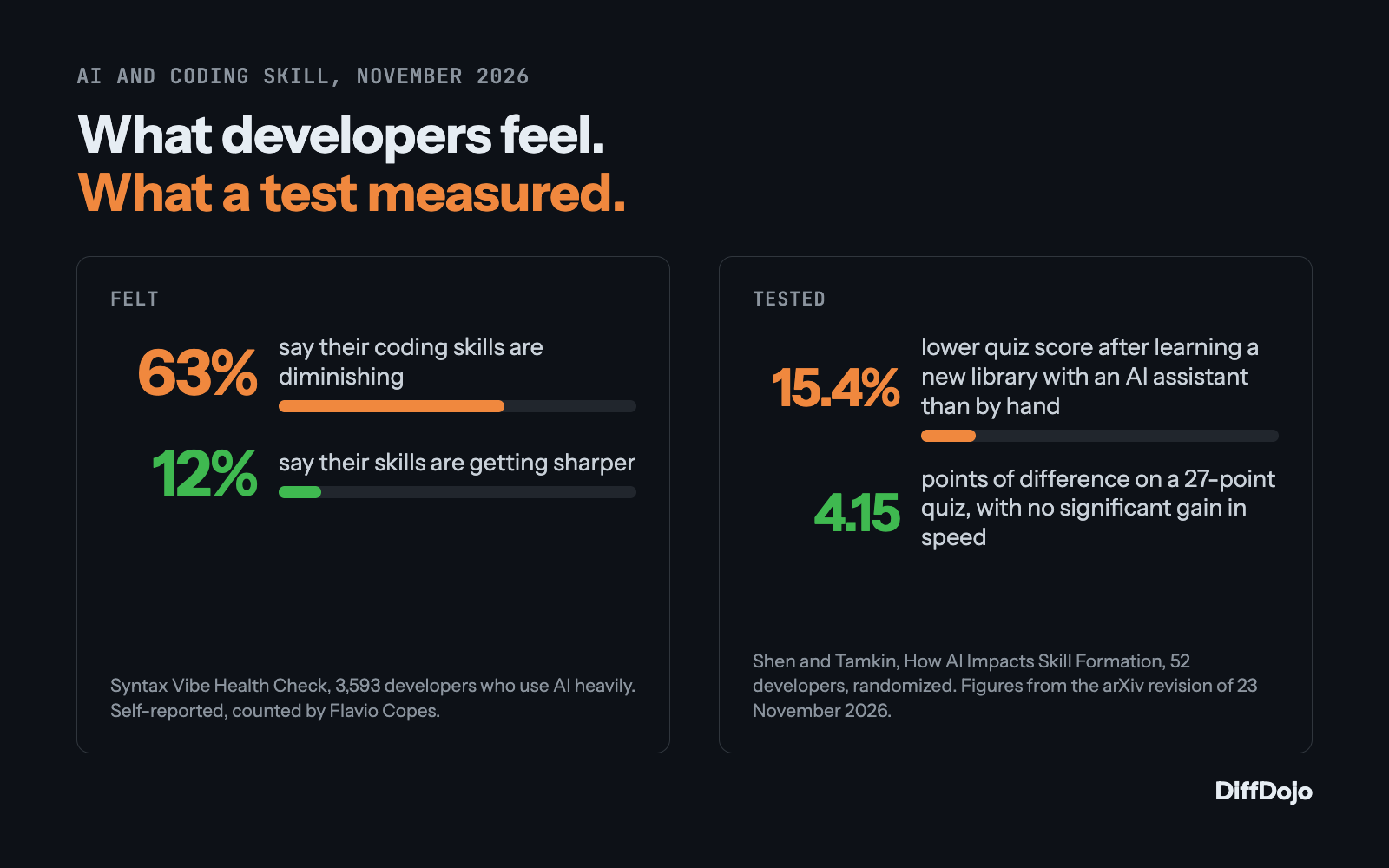
In mid-November a number went around developer feeds: 63% of developers who use AI heavily said their coding skills are diminishing. It comes from Syntax's Vibe Health Check, which asked "Do you feel your actual coding skills are sharpening, holding steady, or diminishing?" On 16 November Flavio Copes went through the results in an essay that starts from a clip Scott Tolinski of Syntax had posted two days earlier: "3,593 developers who use AI heavily answered it", 2,279 of them picked 4 or 5 on a scale that runs from "sharpening" to "diminishing", and 445, about 12%, said their skills are getting sharper. He also wrote the caveat that belongs next to the number: "It’s a survey about how people feel, and nobody’s skills were tested."
A week after that, on 23 November, the study where skills were tested got a new revision on arXiv. It is worth reading the two together.
What was measured, and what was not
A randomized test of developers learning something new. In How AI Impacts Skill Formation, Judy Hanwen Shen and Alex Tamkin had developers with more than a year of Python learn an asynchronous library none of them had used, half with an AI assistant and half without: "52 participants completed the task, 26 for each of the control and treatment groups." Afterwards everyone took the same quiz. The abstract states the result plainly: "AI use impairs conceptual understanding, code reading, and debugging abilities, without delivering significant efficiency gains on average." The 23 November revision is labelled "Corrected numerical issues", and its text gives the size of the effect: "There is a 4.15 point difference between the means of the treatment and control groups. For a 27-point quiz, this translates into a 15.4% score difference or 2 grade points." Anthropic's write-up from January describes the same result as "the AI group averaged 50% on the quiz, compared to 67% in the hand-coding group". Where the two differ, this article uses the revised paper.
The same pattern in three student studies from this year. In a controlled experiment with 55 computer science undergraduates, "ChatGPT-assisted students achieved higher coding scores (89% vs. 69%) but lower recall scores immediately (41% vs. 53%) and after 48 hours (39% vs. 52%)". An in-progress study of 54 students building a website with a coding agent or a chatbot reports: "While agents aid initial task completion, they harm users' code comprehension and thus do not prepare users to extend their code". And a within-subjects study of 15 graduate students working in an unfamiliar codebase with Copilot reported better task performance with "no corresponding improvement in overall comprehension". Its authors conclude that "successful task completion does not reliably indicate code comprehension".
What none of them shows. These studies measure what people take away from one task: a skill that did not form, or an understanding that was not built. None of them follows experienced developers for a year to see whether a skill they already had wears off. The evidence for that is still what people say about themselves, as in the Syntax survey, and what practitioners write: a review of 76 practitioner sources published in October concluded that "cognitive debt can accumulate unnoticed behind working code and passing tests, particularly when developers accept AI-generated solutions without building understanding".
There is one more detail that an article about reading should not skip. In the Shen and Tamkin quiz "the largest score gap occurs in the debugging questions and the smallest score gap in the code reading questions". The authors' explanation is that both groups read plenty of code during the task, while the group without the assistant "encountered more errors during the task and became more capable at debugging". On that reading, code reading held up best because both groups kept doing it, and debugging suffered most in the group that had less of it to do. The practical lesson is short: the skill you keep exercising is the skill you keep.
Why reading is the skill to protect
When an assistant writes the first draft, what is left for the person is deciding whether the draft is right. Shen and Tamkin built their quiz around that. Anthropic's write-up says the assessment "focused most heavily on debugging, code reading, and conceptual problems, as we considered these the most important for providing oversight of what is increasingly likely to be AI-generated code".
The trouble is that an assistant can take the reading over too. It summarises the diff, explains the function and reviews the pull request, and each of those is a read you did not do. The result shows up in review: in the LeadDev AI Code Review Report 2026, only 26% of respondents said they fully understand the AI code they review, and an approval given without understanding is a rubber stamp.
The studies also suggest that how the tool is used matters. Nobody was assigned a way of using it, so this is an association, not a tested method. Shen and Tamkin "identify six distinct AI interaction patterns, three of which involve cognitive engagement and preserve learning outcomes even when participants receive AI assistance". In the write-up's words, the participants who did well "used AI assistance not just to produce code but to build comprehension while doing so". The Copilot study saw the same from the other side: the participants who understood the codebase best kept going back to inspect and revise what had been written, and "performed write-then-view transitions 4.7 times more often than participants with lower comprehension".
Five habits that keep code reading in practice
No controlled study we could find tests a daily reading routine against doing nothing. What follows is built from the behaviours that went with better comprehension in the studies above, plus the ordinary rule that a skill needs repetition and feedback.
1. Predict before you run
Before you run the tests or the code an assistant produced, say what it will do: the return value for one input, which branch executes, what the log line will read. Then run it. A wrong prediction is the most useful thing that can happen to you that day, because it marks the exact spot where your model of the code and the code disagree. If you only ever run it and look, you never learn where that spot is.
2. Trace one input by hand
Pick a value the requirements name, such as an empty list, a null field or a second call, and follow it line by line, keeping track of what each variable holds. You are not reading the whole file with equal care. You are executing a few lines in your head, which is the part of reading that a summary replaces first. The review checklist lists the inputs that are worth the walk.
3. Explain first, then ask
Write two sentences on what the change does before you ask the assistant anything, and then ask it to find what is wrong with your explanation. This is the pattern the high scorers in the Shen and Tamkin study shared: they asked follow-up and conceptual questions and used the assistant to check their own understanding. The low scorers relied on it to write or fix the code. In the paper, the first kind of pattern averaged 65% or higher on the quiz and the second less than 40%. The participants chose their own approach and each cluster is a handful of people, so read it as a strong hint.
4. Keep one unassisted read a day
Choose one pull request or one generated change each day and read it with the AI summary and the AI review closed. Write your verdict first and open the tools after. When they found something you missed, you have a concrete thing to learn. When you found something they missed, you have a reason to keep reading. Start with the smallest change of the day so that it actually happens.
5. Practise where the answer is known
At work nobody tells you a read was wrong until the bug ships, and by then the lesson is months late. Practice needs an answer to compare against, so review code where the defect is known and graded, in short sessions, and include changes that are correct. How to practice code review describes what a session looks like, and the guide to reviewing AI-generated code covers what to look for in it.
A three-line read
Here is a small PR from an agent to try habits 1 and 2 on. The ticket says:
add_item(name, cart=...)appends an item and returns the cart.- Called with no cart, it must start from an empty cart.
- Two independent calls with no cart must not share state.
The PR description says:
Adds the cart helper: appends the item and returns the cart, defaulting to a fresh empty cart when none is passed. Verified by adding a couple of items.
app/cart.py
+3
Before you open the answer, predict one thing: a program calls add_item("pen") and later, somewhere else, add_item("ink"). What does the second call return?
What the second call returns
It returns ["pen", "ink"]. Python evaluates a default argument once, when the function is defined, so cart: list[str] = [] creates a single list and every call that leaves cart out appends to that same list. The second "empty" cart already holds the first caller's item. In a long-running server that list lives across requests.
The verdict is request changes, against the third requirement. The fix is to default to None and build the list inside the function:
def add_item(name: str, cart: list[str] | None = None) -> list[str]:
    if cart is None:
        cart = []
    cart.append(name)
    return cart
If you predicted ["ink"], that is the point of the exercise. The description says "a fresh empty cart", the author's check added a couple of items in a row and saw the list they expected, and the signature reads like the obvious way to say "empty by default". Running it once would not have told you. Predicting the second call does.
Try it yourself
This PR is in DiffDojo, open without signup.
Leave your inline comment and a verdict, and compare your review with the canonical one. It takes a few minutes, which is the size a daily read should be.
Review this PR →What this does not mean
It does not mean writing everything by hand again. Copes's essay is titled "AI is eroding my coding skills, and I don't care", and for recalling syntax that is a defensible position: the assistant covers that gap well. In the Shen and Tamkin study, the participants who had the assistant and still learned the library were the ones who kept asking it questions.
It also does not mean the evidence is settled. The experiments are small, mostly short and mostly about learning something new, and the 63% in the Syntax survey is a feeling. What they agree on is narrower and more useful: finishing a task with an assistant does not reliably tell you whether you understood it, and the only way to find out is to be tested. The Shen and Tamkin paper's own summary is that "AI-enhanced productivity is not a shortcut to competence".
Common questions
How can I keep my code reading skills sharp while using AI coding assistants?
Read some code every working day without the assistant and check yourself against an answer. Predict what a change will do before you run it, trace one concrete input through it by hand, and write your own explanation before you ask the assistant for one. Keep at least one review a day where the AI summary and AI review stay closed until you have a verdict. Add short practice on code with known defects, so that you find out when your reading was wrong. This routine is inferred from what the better-scoring participants did in the studies above. No study has tested it as a programme.
Does using AI coding assistants make your coding skills worse?
They can, and how you use them seems to matter. In a randomized study of 52 developers learning a new Python library, the group with an AI assistant scored 15.4% lower on a follow-up quiz than the group that coded by hand. Within the AI group, participants who asked conceptual questions and checked their own understanding scored well and those who delegated the work scored poorly, which is an observed association and not a tested method. That study measured learning something new. Long-term loss of skills you already have is so far supported mainly by self-reports.
Is reading code a different skill from writing it?
They overlap, and they are practised differently. Writing lets you build the program in your own order with your own names. Reading means reconstructing someone else's intent from the text and working out what the code does for inputs the author may not have considered. You can write fluently and still read carelessly, which is why review needs its own practice.
How much practice does it take to keep code reading sharp?
No study gives a number. Small and regular is a better bet than long and rare: one short change a day, read closely, with a prediction made before running it and an answer to compare against afterwards. If a session does not end with you learning whether you were right, it was reading, not practice.
Where can I practice reading and reviewing code?
DiffDojo is a trainer for this. You review realistic AI-written pull requests, leave inline comments, give a verdict and get graded against a canonical review. Some PRs are correct, so approving is sometimes the right answer. One PR in every stack is open without signup, a free account opens one more of your choice, and the pass opens the rest of the library.
Read next How to stop rubber-stamping AI-generated code Read next How to practice code review